
Understanding the Feminine Force That Dissolves Illusion
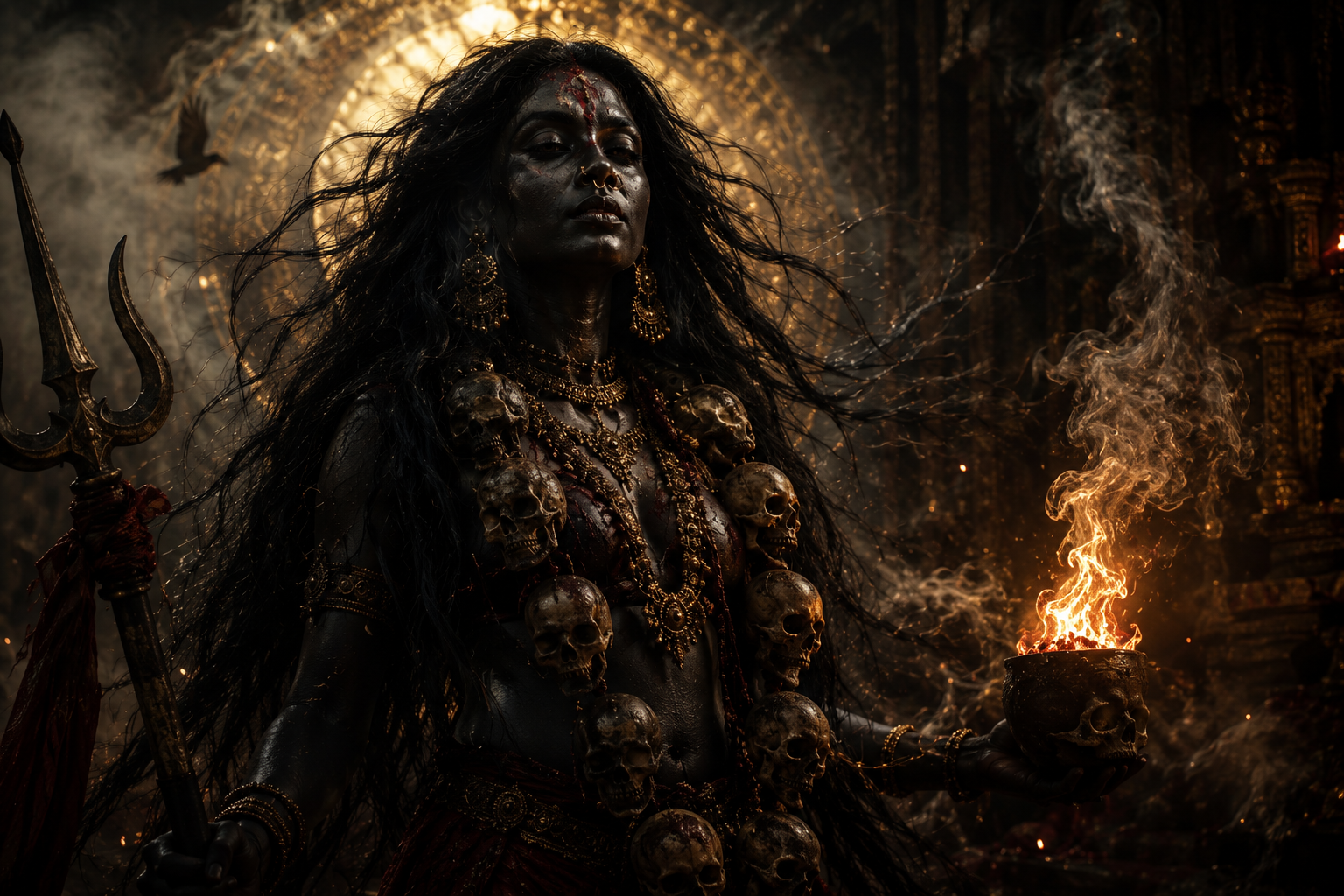
Kali is perhaps one of the most misunderstood archetypes within spiritual traditions. For many people, the first encounter with Kaali happens through imagery that appears frightening — skulls, severed heads, cremation grounds, blood symbolism, dark skin, weapons. Without context, she is often interpreted as a goddess of violence or destruction. But this interpretation comes from reading symbolic imagery literally instead of understanding the philosophical depth from which the archetype emerges.
Kaali is not destruction for the sake of destruction. She represents dissolution — the dissolution of illusion, egoic attachment, false identity, and everything within the psyche that is no longer aligned with truth. Within Hindu philosophy, destruction is not viewed as separate from creation. Life itself functions through continuous cycles of birth, preservation, death, and renewal. Entire phases of existence must collapse for new consciousness to emerge. Kaali governs this sacred process internally.
This is why the Kaali archetype often becomes psychologically relevant during periods of profound personal transformation. People are drawn toward her during heartbreak, grief, betrayal, burnout, spiritual awakening, nervous system exhaustion, or major identity shifts because these are the moments where older structures of the self begin breaking down. The life that once felt sustainable no longer feels true. The identities that once provided safety begin feeling restrictive. Something deeper within the psyche starts demanding honesty.
The Symbolism of Kaali
Ancient spiritual traditions communicated through symbolism because symbols can express psychological and spiritual truths more powerfully than direct explanation. Kaali’s form is deeply symbolic and cannot be understood properly through surface interpretation alone.
Her dark complexion represents the vastness beyond form and ego — the primordial void from which all creation emerges and into which everything eventually dissolves. Her wild hair symbolises freedom from social conditioning and constructed identity. The skulls around her neck represent the death of false selves and the impermanence of egoic attachment. The cremation grounds associated with her symbolise the terrain of transformation, where attachment, illusion, and identity are burned away.
Nothing in Kaali’s imagery is ornamental. Every aspect points toward a confrontation with truth.
This is also why she evokes such strong reactions in people. Most human beings are comfortable with spirituality as long as it remains emotionally soothing or aesthetically pleasing. Kaali disrupts that comfort. She confronts attachment directly. She exposes where the ego clings to familiarity even when that familiarity is causing suffering.
The Kaali Archetype in Women
For women especially, the Kaali archetype carries profound psychological significance because she exists completely outside socially conditioned femininity. She is not restrained for approval. She is not softened to remain acceptable. She does not suppress intensity to preserve comfort around her.
Many women are conditioned from a very young age to survive through accommodation. Emotional restraint becomes associated with maturity. Self-sacrifice becomes associated with love. Silence becomes associated with grace. Over time, women often learn to disconnect from their own instincts to maintain relationships, social acceptance, or emotional safety. This creates fragmentation…
A woman may appear composed externally while internally carrying grief, resentment, exhaustion, shame, rage, and profound emotional suppression. She may continue functioning while feeling increasingly disconnected from herself. The performed self becomes stronger while the authentic self becomes buried underneath years of conditioning.
The Kaali archetype confronts this split directly.
This is one of the reasons many women feel both deeply drawn toward Kaali and deeply unsettled by her at the same time. She represents a form of feminine power that is not rooted in performance. Not power designed to appear spiritual, desirable, emotionally manageable, or aesthetically “dark.” But power rooted in truth.
Kaali exposes where self-abandonment has been normalised.
☾ ◯ ☽
Kaali and Rage
One of the most misunderstood dimensions of the Kaali archetype is rage. Historically, feminine anger has been treated as something threatening or spiritually inappropriate. Women are often taught to suppress anger long before they fully understand what anger actually is.
But suppressed anger does not disappear. It moves inward.
Sometimes it becomes anxiety. Sometimes chronic emotional exhaustion. Sometimes, numbness, people-pleasing, hyper-independence, resentment, or depression. Many women carrying profound exhaustion are carrying years of unprocessed emotional suppression within the nervous system.
The Kaali archetype brings this material into awareness.
Not to make a woman destructive, but to reconnect her with the parts of herself she was taught to reject. Kaali does not glorify uncontrolled rage. She represents conscious confrontation with truth. In many cases, anger is not the problem itself. Anger is the signal that something within the self has been repeatedly violated, ignored, silenced, or betrayed.
The archetype becomes transformative when that anger is understood consciously instead of suppressed unconsciously.
Kaali and Ego Dissolution
Psychologically, the Kaali archetype is deeply connected to ego dissolution. Not ego death in the exaggerated way modern spirituality often describes it, but the dismantling of identities built entirely around fear, validation, attachment, and survival.
Every human being creates identities to secure belonging and emotional safety. This is natural. But over time, these identities can become prisons when they are no longer rooted in authenticity. People continue performing versions of themselves that once protected them but now exhaust them. Kaali enters where these structures begin collapsing.
This is why genuine encounters with the Kaali archetype often coincide with periods of emotional unravelling. Relationships shift. Priorities change. Long-suppressed truths surface unexpectedly. A person may begin recognising how much of their life was constructed around avoidance rather than truth.
Kaali removes illusion, but she does not remove what is real. That is an important distinction.
Why the Kaali Archetype Matters Today
The growing attraction toward Kaali is not accidental. Many people, especially women, are exhausted from living disconnected from themselves. Emotional suppression has been mistaken for maturity for far too long. Self-abandonment has been romanticised as love, spirituality, sacrifice, and strength. Entire identities have been built around emotional performance rather than authenticity.
The Kaali archetype becomes relevant precisely at the point where that fragmentation can no longer continue.
This is why Kaali resonates so strongly culturally and psychologically in the current moment. She represents the refusal to continue living divided between truth and performance. She represents the part of the psyche that can no longer tolerate illusion simply because it feels familiar.
At her core, Kaali is not a goddess of punishment. She is a force of awakening. She dismantles what is false so that something more truthful can emerge underneath it.
And perhaps this is why people who are genuinely drawn toward Kaali rarely experience her as separate from themselves. The archetype does not simply exist externally as mythology. At some point, it becomes an internal process — a confrontation with everything within us that is no longer willing to live disconnected from truth.



0 Comments