
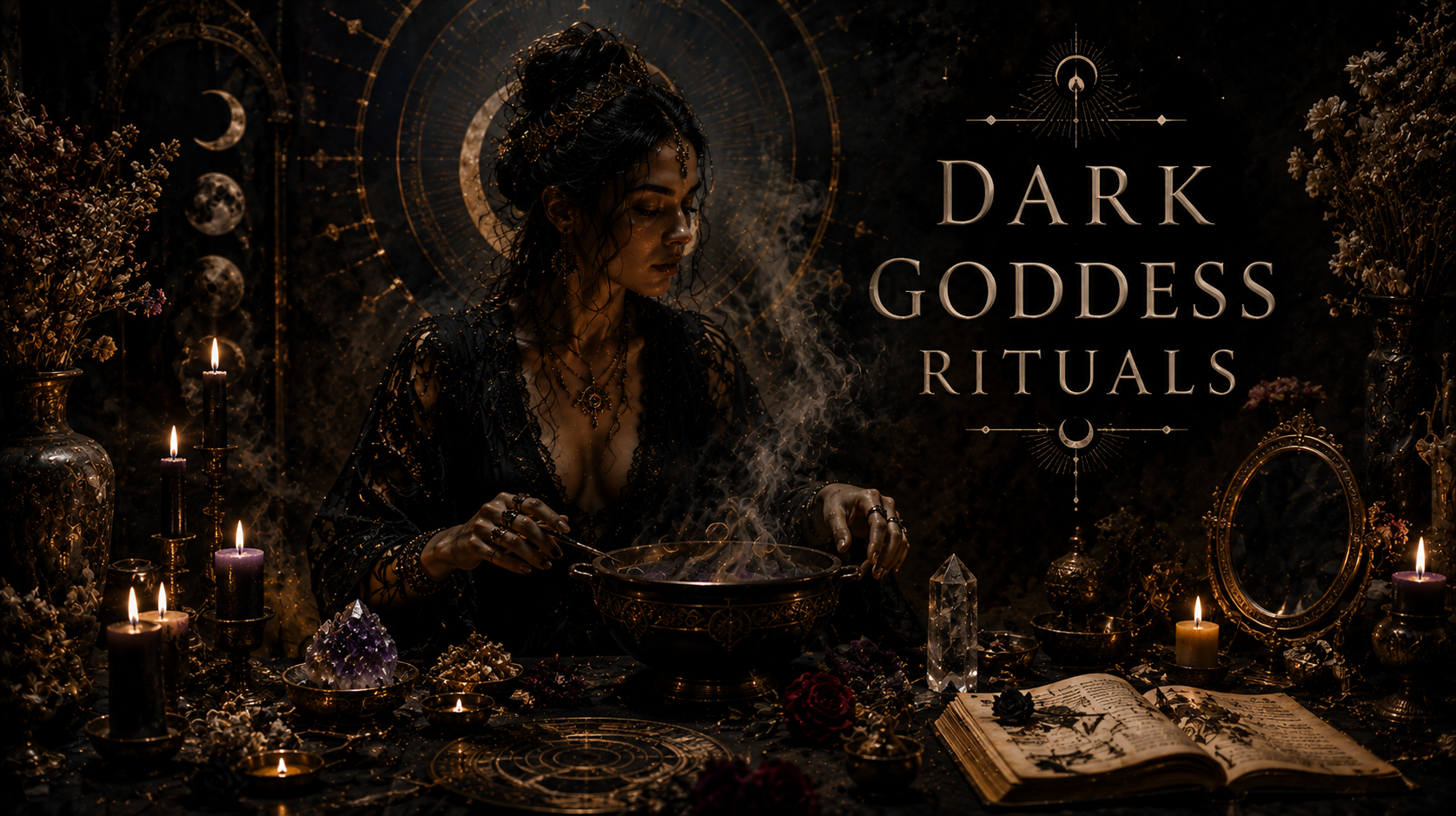
Sacred Practices for Shadow Work, Feminine Healing, and Inner Transformation
The rise of Dark Goddess spirituality has created enormous curiosity around rituals connected to the feminine shadow. Yet most conversations around Dark Goddess rituals remain either overly aesthetic or deeply misunderstood. Social media often presents these practices as dramatic ceremonies involving candles, moon water, seductive energy, or occult symbolism while completely ignoring the deeper psychological and spiritual purpose behind them.
A Dark Goddess ritual is not simply a spiritual performance.
It is a symbolic process of inner confrontation, release, transformation, and reclamation.
Historically, rituals existed to help human beings move consciously through transitions. Ancient cultures understood that emotional transformation required intentional space. Grief, endings, initiation, death-rebirth cycles, and psychological change were not treated casually. Ritual created a container where the unconscious mind, body, emotions, and spirit could process transformation together.
This is why Dark Goddess rituals are deeply connected to shadow work.
They are not about “becoming dark.”
They are about becoming conscious.
☾ ◯ ☽
What Is a Dark Goddess Ritual?
A Dark Goddess ritual is a symbolic spiritual or psychological practice designed to help a person confront, release, integrate, or reclaim aspects of themselves that have been suppressed, denied, or emotionally buried.
These rituals are often connected to:
✦ Shadow work
✦ Grief processing
✦ Emotional release
✦ Boundary reclamation
✦ Feminine healing
✦ Ego death
✦ Intuition
✦ Sensual embodiment
✦ Nervous system healing
✦ Transformation after loss or heartbreak
Unlike manifestation rituals, which are usually future-oriented, Dark Goddess rituals are focused on descent and emotional truth. They ask a woman to pause long enough to witness what has been emotionally avoided.
This is why these rituals often emerge during periods of:
✦ Heartbreak
✦ Burnout
✦ Emotional collapse
✦ Identity shifts
✦ Spiritual awakening
✦ Trauma healing
✦ Major life transitions
The ritual itself becomes a threshold between the old self and the emerging self.
☾ ◯ ☽
The Psychological Purpose Behind Ritual
Modern spirituality often treats ritual as superstition or aesthetic theatre, but psychologically, rituals serve an extremely important function.
The unconscious mind responds deeply to symbolism.
Human beings naturally process transformation through symbolic action. This is why funerals, weddings, initiation rites, fasting practices, prayer ceremonies, and sacred transitions have existed across cultures for centuries. Ritual communicates to the psyche that something significant is happening internally.
When done consciously, Dark Goddess rituals help externalise internal transformation. They create emotional and psychological containers where suppressed feelings can surface safely.
For example:
❖ Burning letters may symbolise release
❖ Mirrors may symbolise self-confrontation
❖ Water rituals may symbolise emotional cleansing
❖ Darkness may symbolise descent into the unconscious
❖ Candles may symbolise awareness and truth
❖ Veiling may symbolise grief, mystery, or inner withdrawal
The ritual itself is not “magic” in the fantasy sense.
The transformation happens through awareness, emotional honesty, nervous system regulation, symbolic meaning, and conscious engagement with the psyche.
☾ ◯ ☽
Why Women Feel Drawn Toward Dark Goddess Rituals
Many women are emotionally exhausted from constantly performing functional versions of themselves while remaining disconnected internally.
Modern life rewards productivity, emotional composure, social acceptability, and endless external functioning. As a result, women often suppress enormous amounts of emotional material simply to survive daily life.
Dark Goddess rituals create space for the emotions society usually teaches women to silence:
✦ Rage
✦ Grief
✦ Desire
✦ Emotional exhaustion
✦ Resentment
✦ Heartbreak
✦ Intuition
✦ Sensuality
✦ Fear
✦ Emotional truth
This is why many women feel profoundly emotional during these practices. The ritual interrupts performance.
For perhaps the first time in a long time, the woman is no longer managing perception.
She is simply witnessing herself honestly.
☾ ◯ ☽
The Ritual of Release
One of the most powerful Dark Goddess rituals is the ritual of release.
This ritual becomes especially important during periods of heartbreak, betrayal, grief, emotional attachment, or identity collapse. Psychologically, human beings often struggle to release emotions because the nervous system remains attached to familiarity, even when that familiarity is painful.
The purpose of a release ritual is not to force emotional detachment instantly. It is to consciously acknowledge that something has ended.
A simple release ritual may involve:
✦ Writing down identities, attachments, memories, or beliefs that no longer feel aligned
✦ Reading them aloud honestly
✦ Burning or burying the paper symbolically
✦ Sitting in silence afterwards without distraction
What matters is not theatrical intensity.
What matters is emotional presence.
The ritual becomes powerful when the woman allows herself to fully witness what she has been emotionally unable to admit.
☾ ◯ ☽
Mirror Rituals and Self-Confrontation
Mirror rituals are deeply connected to Dark Goddess work because mirrors symbolically represent truth, identity, self-perception, and confrontation with the self.
Many women spend years seeing themselves only through conditioning:
who they should be, how they should behave and how emotionally acceptable they should remain.
Mirror rituals interrupt this conditioning.
A woman may sit in front of a mirror in candlelight or silence and simply observe herself without trying to fix, improve, perform, or analyse. Often, emotions surface unexpectedly because the ritual bypasses intellectual defence mechanisms.
Some women experience:
✦ Grief
✦ Rage
✦ Shame
✦ Emotional numbness
✦ Vulnerability
✦ Deep compassion for themselves
The ritual itself is deceptively simple.
The confrontation is internal.
☾ ◯ ☽
Dark Moon Rituals and the Feminine Shadow
Dark Goddess rituals are often associated with the Dark Moon phase—the period just before the New Moon, where the moon disappears from visibility entirely.
Symbolically, the Dark Moon represents:
✦ Endings
✦ Rest
✦ Ego dissolution
✦ Grief
✦ Stillness
✦ Descent
✦ Introspection
✦ The unconscious mind
Unlike Full Moon rituals, which are often emotionally expressive or externally energetic, Dark Moon rituals tend to be quieter and more psychologically introspective.
This phase is ideal for:
❖ Shadow journaling
❖ Meditation
❖ Emotional processing
❖ Grief work
❖ Dream work
❖ Silence
❖ Nervous system regulation
❖ Solitude
The Dark Moon teaches a lesson modern culture deeply resists:
Not all transformations require constant action. Some transformation requires stillness.
☾ ◯ ☽
Sensuality Rituals and Reclaiming the Body
One of the most misunderstood dimensions of Dark Goddess work is sensuality.
Modern culture often reduces feminine sensuality either into objectification or spiritual shame. As a result, many women become deeply disconnected from their own bodies. They live intellectually and emotionally while remaining dissociated physically.
Dark Goddess rituals connected to sensuality are not necessarily sexual.
They are often about reconnecting with:
✦ Pleasure
✦ Embodiment
✦ Creativity
✦ Emotional safety within the body
✦ Movement
✦ Desire
✦ Self-expression
✦ Nervous system presence
This may involve:
❖ Dance
❖ Oil rituals
❖ Baths
❖ Music
❖ Slow movement practices
❖ Breathwork
❖ Adornment rituals
The goal is not seduction or performance.
The goal is reconnection.
For many women, reclaiming sensuality is actually shadow work because shame, conditioning, trauma, or objectification created deep disconnection from the body itself.
☾ ◯ ☽
Grief Rituals and Emotional Processing
One of the most neglected aspects of modern healing culture is grief.
Most people are never taught how to process endings consciously. Instead, they are encouraged to remain productive, stay positive, or emotionally bypass pain entirely.
Dark Goddess rituals create space for grief without trying to rush transformation.
Grief rituals may involve:
✦ Candle ceremonies
✦ Water rituals
✦ Journaling
✦ Prayer
✦ Solitude
✦ Music
✦ Crying intentionally without suppression
✦ Creating ancestral or memory altars
Grief is not weakness.
It is evidence of attachment, meaning, depth, and love.
Many women carrying chronic numbness are actually carrying unprocessed grief underneath. This is why grief rituals can feel profoundly healing. They allow emotional energy trapped within the nervous system to finally move.
☾ ◯ ☽
The Importance of Safety in Shadow Rituals
One of the biggest mistakes people make with Dark Goddess work is romanticising emotional intensity without understanding psychological safety.
Not every person should immediately dive into deep shadow work alone, especially individuals dealing with severe trauma, dissociation, depression, or nervous system dysregulation.
Dark Goddess rituals are most transformative when approached slowly, consciously, and with grounding.
This is why genuine shadow work often includes:
✦ Therapy
✦ Somatic healing
✦ Meditation
✦ Breathwork
✦ Emotional support systems
✦ Nervous system regulation
✦ Journaling
✦ Conscious integration practices
The goal is not emotional overwhelm.
The goal is awareness.
Transformation does not happen through chaos alone.
It happens through conscious integration.
☾ ◯ ☽
The Difference Between Ritual and Performance
One of the reasons Dark Goddess spirituality sometimes becomes superficial online is because rituals are turned into visual performance rather than emotional process.
Candles, veils, crystals, incense, dark aesthetics, or elaborate altars are not inherently meaningful on their own.
Without emotional honesty, the ritual remains decorative.
A woman can perform spirituality beautifully while remaining deeply disconnected from herself internally.
True Dark Goddess ritual work is rarely about looking mystical.
It is about creating enough silence to hear what the psyche has been trying to say underneath distraction, conditioning, and emotional suppression.
Sometimes the deepest ritual is simply sitting alone in truth without escaping it.
☾ ◯ ☽
The Real Purpose of Dark Goddess Rituals
Ultimately, Dark Goddess rituals are not about darkness for the sake of darkness.
They are about transformation.
They create symbolic containers where women can consciously confront grief, rage, identity shifts, emotional wounds, suppressed desires, intuition, endings, and rebirth without immediately trying to sanitize the experience into positivity.
The Dark Goddess does not ask women to become emotionally heavier or more dramatic.
She asks women to stop abandoning the parts of themselves that need witnessing.
Because healing is not only about becoming lighter.
Sometimes healing begins the moment a woman finally allows herself to fully enter the darkness she spent years trying to avoid.




0 Comments