
Understanding the Feminine Psyche Through Myth, Psychology, and Inner Transformation
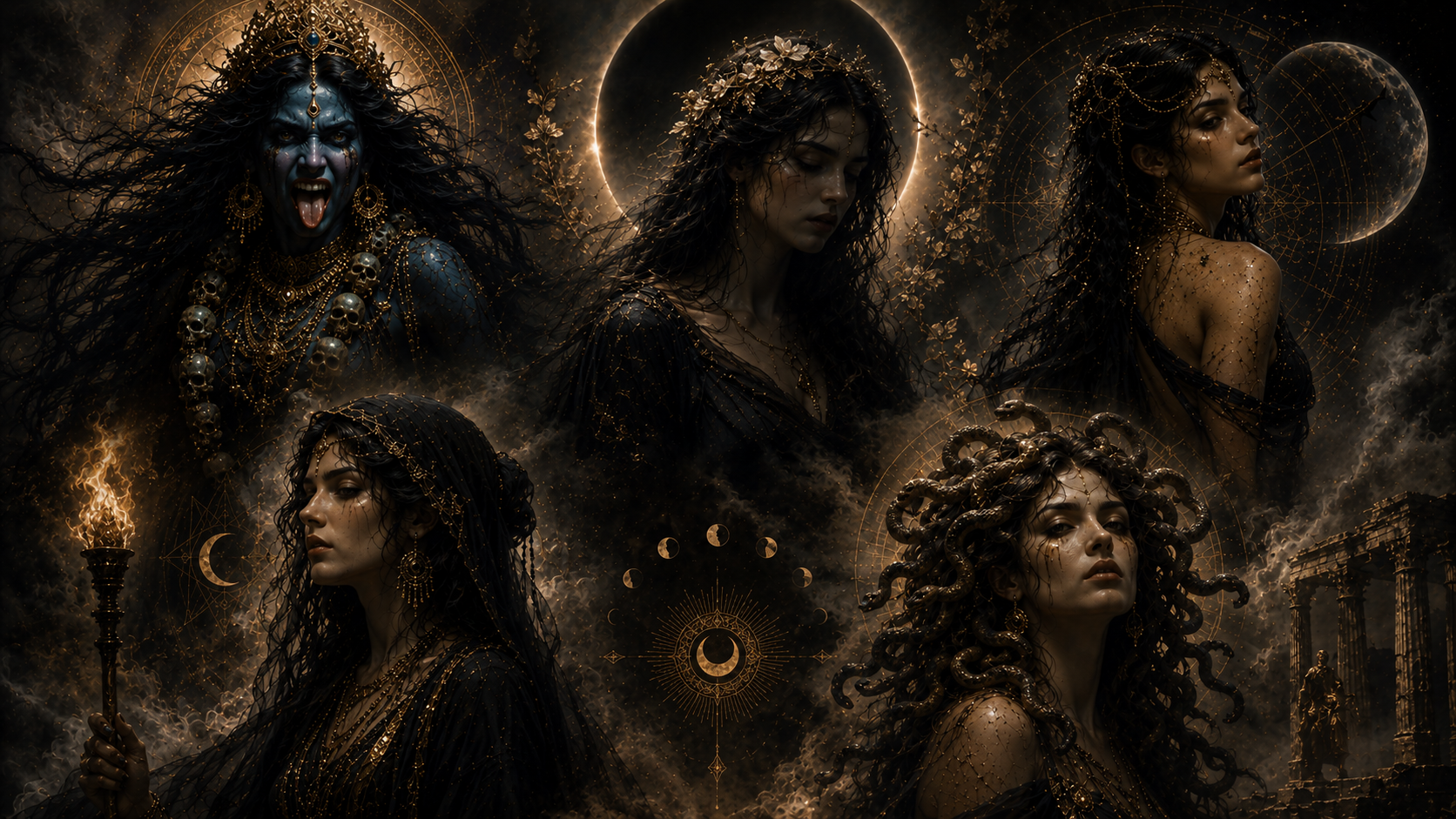
The conversation around the Dark Goddess has expanded rapidly over the last few years, yet most discussions around it remain surprisingly superficial. Social media has largely reduced the Dark Feminine into an aesthetic category… dark clothing, seductive energy, emotional detachment, witchcraft symbolism, or hyper-mysterious femininity, while completely missing the deeper psychological and spiritual meaning behind these archetypes.
Dark Goddess archetypes are not trends, personalities, or identities women are supposed to imitate.
They are symbolic representations of different aspects of the feminine psyche that have historically been suppressed, feared, rejected, or misunderstood. These archetypes appear across mythology, religion, psychology, dreams, and storytelling because they reflect emotional truths that women experience universally across cultures and generations.
What makes Dark Goddess archetypes so powerful is that they govern the emotional territories most people spend their lives trying to avoid—grief, rage, sexuality, endings, trauma, instinct, emotional truth, ego death, transformation, and feminine power.
This is also why they are inseparable from shadow work.
The deeper a woman explores these archetypes consciously, the more she begins confronting aspects of herself that were buried beneath conditioning, survival patterns, shame, and emotional suppression.
What Is an Archetype?
Before understanding Dark Goddess archetypes specifically, it is important to understand what an archetype actually is.
Psychologist Carl Jung described archetypes as universal symbolic patterns that exist within the collective unconscious. These patterns appear repeatedly throughout mythology, spirituality, literature, religion, and human behaviour because they represent recurring psychological experiences shared by humanity.
For example, almost every culture contains versions of:
♦ the mother
◊ the maiden
♦ the warrior
◊ the healer
♦ the mystic
◊ the destroyer
♦ the wise woman
Dark Goddess archetypes belong to the aspects of feminine consciousness connected to transformation and the unconscious mind. They often emerge during emotionally intense periods of life because they represent phases of psychological death and rebirth.
A woman rarely becomes interested in Dark Goddess work when life feels emotionally safe and stable. These archetypes usually appear during periods of:
- heartbreak
- burnout
- grief
- trauma healing
- spiritual awakening
- emotional collapse
- identity crisis
- nervous system exhaustion
- major life transitions
This is because archetypes become psychologically relevant when the psyche itself is demanding transformation.
Why These Archetypes Are Called “Dark”
The word “dark” has been misunderstood for centuries because modern culture associates darkness only with negativity. But spiritually and psychologically, darkness has always represented the unknown, the hidden, and the transformational.
Darkness is where endings happen.
Darkness is where rebirth begins.
Seeds grow underground before they bloom. The womb itself is dark. Human beings psychologically transform during periods where certainty disappears and emotional truth becomes unavoidable.
The Dark Goddess governs these inner underworlds.
She represents the parts of the feminine psyche connected to:
- emotional depth
- instinct
- grief
- rage
- sensuality
- mystery
- endings
- rebirth
- shadow integration
- truth beyond performance
Historically, many of these qualities became threatening to patriarchal societies because they were difficult to control. Women who embodied emotional truth, intuitive power, sexual autonomy, or spiritual authority were often feared, demonised, or misunderstood.
This is why many Dark Goddess figures across mythology were eventually portrayed as dangerous, destructive, chaotic, or monstrous.
Psychologically, however, these archetypes reveal something much deeper: the feminine psyche cannot remain fragmented forever.
Kali — The Archetype of Destruction and Liberation
Kali is perhaps one of the most misunderstood Dark Goddess archetypes because her imagery appears frightening to the modern mind. She is often depicted wearing skulls, standing in cremation grounds, holding weapons, and surrounded by symbolism associated with death.
But Kali does not represent evil.
Kali represents destruction as liberation.
Psychologically, Kali governs the collapse of false identity. She appears when the structures a woman built her life around can no longer sustain her psychologically or spiritually. Relationships end. Performative identities begin cracking. Emotional suppression stops working. Survival patterns collapse.
Kali energy often emerges during periods where women are being forced into radical honesty with themselves.
A woman moving through Kali archetype work may begin confronting questions like:
Who am I without the identities I created for acceptance?
What parts of my life are built around fear rather than truth?
What needs to end for transformation to begin?
This is why Kali archetype work can feel emotionally intense. Kali dismantles illusion before transformation can happen. She is associated with ego death, not because she wants destruction for its own sake, but because healing often requires the collapse of identities rooted in self-abandonment.
Women deeply connected to Kali energy are often learning how to stop betraying themselves emotionally.
Persephone — The Archetype of Descent Into the Underworld
Persephone represents a very different form of darkness.
Unlike Kali, whose energy is explosive and confrontational, Persephone governs psychological descent. Her mythology centres around entering the underworld and emerging transformed by the experience.
Persephone begins as the maiden archetype — innocent, protected, emotionally untouched by suffering. But after her descent into the underworld, she becomes Queen of the Underworld itself.
Psychologically, Persephone represents the woman whose innocence has been interrupted by reality.
This archetype frequently appears during periods of grief, heartbreak, loneliness, depression, trauma, or major emotional transformation. Women connected to Persephone energy are often moving through the painful transition from emotional innocence into emotional depth.
The Persephone archetype is deeply connected to shadow work because it asks women to stop avoiding emotional darkness and instead learn how to move consciously through it.
Many women unconsciously remain attached to the desire to stay emotionally “safe,” externally validated, rescued, or untouched by suffering. Persephone archetype work dismantles this illusion.
It teaches emotional maturity through descent.
Lilith — The Archetype of Repressed Feminine Power
Lilith has become one of the most psychologically significant Dark Feminine archetypes in modern feminine healing work.
Lilith represents the feminine that refuses submission.
Over centuries, Lilith became symbolic of the aspects of women that patriarchal systems feared most:
- feminine autonomy
- sexual sovereignty
- emotional intensity
- instinct
- independence
- refusal to conform
- unapologetic selfhood
This is why Lilith archetype work often feels deeply activating for women. Many women were conditioned from childhood to suppress precisely these qualities to remain socially acceptable.
Women were rewarded for being:
- accommodating
- emotionally digestible
- self-sacrificing
- agreeable
- nurturing without boundaries
As a result, many women learned to disconnect from authentic desire, anger, sensuality, and instinctive power.
Lilith archetype work revolves heavily around shame.
Not only sexual shame, but shame around being visible, powerful, expressive, emotional, ambitious, or difficult to control. Women drawn toward Lilith energy are often healing people-pleasing, self-silencing, fear of rejection, and the unconscious belief that they must abandon themselves in order to be loved.
Hecate — The Archetype of Intuition and Inner Wisdom
Hecate governs crossroads, transitions, intuition, and liminal spaces. She represents the feminine mystic — the woman who learns to trust inner knowing over external validation.
Hecate archetype energy tends to emerge during transitional periods where a woman no longer feels aligned with her old identity but has not yet fully stepped into the next version of herself.
Psychologically, this archetype becomes important during:
- spiritual awakening
- solitude
- identity shifts
- intuitive awakening
- emotional uncertainty
- major life decisions
Unlike more emotionally explosive archetypes, Hecate’s energy feels quieter and more introspective. Women connected to this archetype are often learning how to sit inside uncertainty without abandoning their intuition.
The shadow work connected to Hecate often involves recognising how deeply women have been conditioned to distrust themselves.
Many women override their intuition constantly because external approval feels safer than the inner truth. Hecate archetype work asks women to rebuild trust with their own inner voice.
Medusa — Trauma, Rage, and Emotional Petrification
Medusa has undergone one of the most profound psychological reinterpretations in modern feminine healing work.
Historically portrayed as monstrous, Medusa is now increasingly understood symbolically as representing wounded femininity transformed through trauma, violation, shame, and rejection.
Psychologically, Medusa represents what happens when pain becomes exiled rather than processed consciously.
Women deeply connected to Medusa archetype energy are often carrying unresolved rage, emotional numbness, distrust, shame, or trauma connected to betrayal, abuse, humiliation, objectification, or emotional violation.
One of the reasons the Medusa archetype resonates so strongly today is that many women have unconsciously learned to disconnect from softness and vulnerability as protective mechanisms.
The shadow work connected to Medusa is not about “becoming powerful” through hardness.
It is about learning whether wounded femininity can heal without permanently closing itself off emotionally.
What Shadow Work Actually Means
Shadow work is one of the most misunderstood concepts in modern spirituality.
Many people speak about shadow work abstractly without understanding what it psychologically involves. Shadow work is the process of becoming conscious of the parts of ourselves that were pushed into the unconscious because they felt unsafe, shameful, socially unacceptable, or emotionally overwhelming.
For women, this often includes:
- anger
- jealousy
- grief
- sexual desire
- emotional intensity
- ambition
- resentment
- fear
- dependency
- instinct
- vulnerability
- power
The shadow itself is not inherently negative.
The danger comes from what remains unconscious.
Suppressed emotions do not disappear simply because they are ignored. They often resurface indirectly through anxiety, burnout, emotional numbness, resentment, self-sabotage, people-pleasing, hyper-independence, toxic relationships, or nervous system dysregulation.
This is why Dark Goddess archetypes are so deeply connected to shadow work. Each archetype symbolically reveals emotional material the psyche is trying to bring into awareness.
How to Actually Begin Shadow Work
Real shadow work is far less glamorous than social media makes it appear.
It is not about romanticising darkness or performing emotional intensity. Genuine shadow work requires honesty, emotional responsibility, nervous system awareness, and self-observation.
For many women, shadow work begins very simply:
by noticing emotional triggers honestly.
Strong emotional reactions often reveal unconscious wounds or suppressed emotions underneath them. For example, chronic people-pleasing may reveal fear of abandonment. Emotional numbness may reveal suppressed grief. Difficulty setting boundaries may reveal fear of rejection or shame around anger.
Shadow work practices may include:
- therapy
- somatic healing
- journaling
- meditation
- inner child work
- nervous system regulation
- dream work
- emotional reflection
- archetypal exploration
One of the most important parts of shadow work is learning to observe emotions without immediately judging them.
Anger does not automatically make someone toxic.
Grief does not make someone weak.
Desire does not make someone impure.
Sensitivity does not make someone unstable.
Shadow work teaches women to hold emotional complexity consciously rather than suppress it unconsciously.
The Real Purpose of Dark Goddess Work
Ultimately, Dark Goddess archetypes are not about becoming darker, colder, more intimidating, or emotionally detached.
They are about becoming psychologically whole.
For centuries, women were taught to embody only the socially acceptable aspects of femininity — softness, nurturing, emotional accommodation, beauty, sacrifice, and agreeability. But the feminine psyche contains far more than softness alone.
It also contains instinct.
Rage.
Wisdom.
Sensuality.
Mysticism.
Grief.
Power.
Transformation.
Truth.
Dark Goddess archetypes remind women that these dimensions are not flaws to eliminate.
They are parts of the self waiting to be integrated consciously.
And perhaps that is why these archetypes are returning so strongly now. Women are no longer interested in spirituality that asks them to suppress themselves to appear healed.
They are searching for wholeness instead.




0 Comments