
Rituals, Crystals, Oils, and Sacred Practices
Working with Kali is not about invoking fear or intensity for the sake of experience. Kaali is a deeply sacred energy. She strips away illusion, but she also brings immense clarity, grounding, protection, and truth into a person’s life. People often speak about her only through destruction, but there is profound love in Kaali. Fierce love. The kind that refuses to let you continue abandoning yourself.
Kaali rituals are most powerful when approached with sincerity rather than performance. A simple diya lit with devotion carries far more energy than an elaborate ritual done without presence. The atmosphere matters. The intention matters. Your inner state matters.
Kaali responds to honesty.
☾ ◯ ☽
Creating a Sacred Space
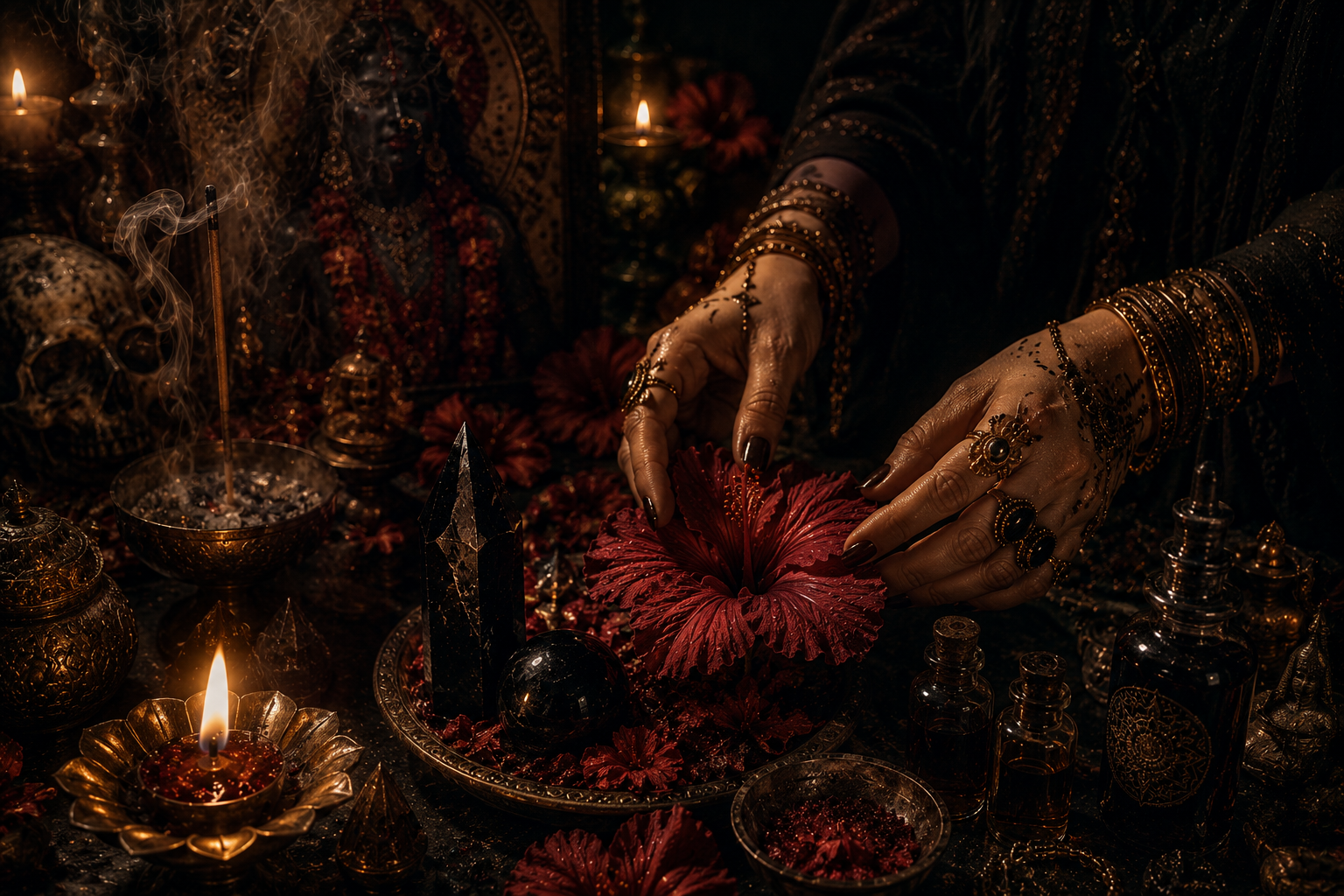
A Kaali altar does not need to be visually excessive. In fact, the deeper the practice becomes, the simpler it often gets. A dark cloth, a photograph or murti of Kaali, incense, flowers, a candle or diya, and silence are enough to begin.
Many people naturally feel drawn toward darker tones during Kaali rituals, deep reds, black, ash tones, muted golds—because these colours carry the feeling of grounding, dissolution, stillness, and Shakti. The atmosphere should feel intimate and sacred rather than decorative.
Music also changes the energy of the ritual space significantly. Traditional Kaali mantras, low temple bells, deep ambient chants, or even silence can create a feeling of entering inwardly rather than remaining mentally distracted.
☾ ◯ ☽
Oils for Kaali Rituals
Fragrance has always played an important role in ritual work because scent changes the emotional and energetic atmosphere almost instantly. Certain oils naturally deepen stillness, embodiment, and presence.
Some oils that resonate beautifully with Kaali energy include:
☽ Sandalwood — grounding, devotional, deeply calming for meditation and mantra work
☽ Vetiver — earthy and stabilising, especially powerful during emotional overwhelm or shadow work
☽ Patchouli — grounding and sensual in an ancient, primal way; helps bring awareness back into the body
☽ Jasmine — connected to feminine depth, emotional openness, and sacred sensuality
☽ Rose — softens emotional armour while keeping the heart open during transformation
☽ Frankincense — creates spiritual focus, inner silence, and ritual atmosphere
These oils may be used for self-anointing, ritual baths, meditation, or applied lightly before mantra chanting. Over time, even the fragrance itself begins carrying the feeling of devotion and sacred stillness.
☾ ◯ ☽
Crystals Connected to Kaali Energy
Crystals within Kaali work are less about “manifestation” and more about grounding, truth, emotional protection, and transformation. They support inner work rather than replace it.
Some crystals strongly associated with Kaali energy are:
☽ Black Tourmaline — grounding, energetic protection, stabilising heavy emotional energy
☽ Obsidian — powerful for shadow work, emotional truth, and confronting unconscious patterns
☽ Garnet — life force energy, courage, primal feminine energy, embodiment
☽ Smoky Quartz — emotional release, grounding during grief or transformation
☽ Labradorite — intuition, psychic sensitivity, inner transformation
☽ Moonstone — feminine wisdom, emotional depth, lunar energy, intuition
Obsidian especially carries very intense energy during Kaali practices because it tends to surface emotional material quickly. Many people naturally feel emotionally exposed while working with it. It is often best approached slowly and consciously.
☾ ◯ ☽
Mantras and Invocation
One of the most traditional ways of invoking Kaali is through a mantra. Sound has always held immense importance within Hindu spiritual traditions because mantra works beyond the intellectual mind. Repetition changes breath, awareness, nervous system rhythm, and internal focus.
One of the most widely used Kaali mantras is:
“Om Kreem Kalikayai Namah”
The bija “Kreem” carries transformative Shakti energy and is deeply associated with dissolution, awakening, and inner power. Repeating this mantra slowly, consistently, and devotionally creates a very different experience than chanting mechanically.
There comes a point where the mantra stops feeling verbal and begins feeling alive within the body itself.
☾ ◯ ☽
Ritual Baths and Offerings
Water rituals can become deeply powerful during Kaali work, especially during periods of grief, emotional release, or transformation.
Many women create ritual baths with:
☽ rose petals
☽ sandalwood oil
☽ black salt
☽ jasmine flowers
☽ incense or candles
☽ mantra playing softly in the background
The intention is not aesthetic self-care. It is energetic cleansing, emotional release, and returning to the body consciously.
Offerings made to Kaali are traditionally rooted in devotion rather than perfection. Red hibiscus flowers are especially associated with her energy. Incense, fruits, sweets, rice, diya light, and prayer are all commonly used offerings within devotional practices.
But the deepest offering is always sincerity.
☾ ◯ ☽
The Inner Experience of Kaali Work
Authentic Kaali work changes a person internally long before anything changes externally.
People often begin confronting emotional truths they previously avoided. Old attachments become difficult to maintain. Self-abandonment becomes impossible to ignore. There is often a stronger pull toward solitude, silence, shadow work, meditation, nervous system healing, and emotional honesty.
Kaali has a way of bringing people back into contact with themselves.
Not the performed self.
Not the spiritually polished self.
The real self underneath it all.
And this is why people who genuinely work with Kaali often describe the experience not as frightening, but as deeply sacred.





0 Comments