
Beyond Fear and Misinterpretation
Kali is perhaps one of the most misunderstood deities within Hindu spirituality.
For many people, the first encounter with Kaali happens through imagery that feels overwhelming — the skulls, the severed heads, the cremation grounds, the blood symbolism, the protruding tongue. Without understanding the symbolic language of Tantra and ancient spiritual traditions, Kaali is often reduced to a goddess of violence or destruction.
But Kaali was never meant to be understood literally.
She represents one of the deepest truths within existence: that anything false eventually collapses.
Kaali is not chaos. She is not evil. And she is certainly not destruction without purpose. She is the force that dissolves illusion — the force that removes whatever prevents truth from being seen clearly. This is precisely why she feels confronting to the human ego.
Most people are comfortable with spirituality when it reassures them. When it comforts identity. When it feels soft, emotionally safe, and aesthetically pleasing.
Kaali does none of these things.
She interrupts the illusion completely.
☾ ◯ ☽
Kaali and Sacred Destruction
One of the greatest misconceptions around Kaali is the assumption that destruction is inherently negative. But within Hindu philosophy, destruction is not separate from creation. Life itself moves through cycles of creation, preservation, dissolution, and rebirth continuously. Entire seasons die so new ones can emerge. Forests burn so new ecosystems can form. Relationships end. Identities collapse. Human beings transform through endings far more than they transform through comfort.
Kaali governs this sacred dissolution.
Not because suffering itself is holy, but because attachment often prevents transformation.
This is why Kaali energy becomes psychologically relevant during periods where the old self can no longer survive intact. Heartbreak, burnout, grief, betrayal, nervous system exhaustion, spiritual awakening, emotional collapse—these are often the moments where people begin feeling drawn toward her. Not because they consciously seek destruction, but because something within them already knows that the life they are living is no longer sustainable.
Kaali enters where performance begins collapsing.
☾ ◯ ☽
The Symbolism of Kaali
Ancient spiritual traditions communicated through symbols because symbols express psychological truths far more deeply than literal language ever can. Kaali’s form is entirely symbolic. Nothing within her imagery is accidental.
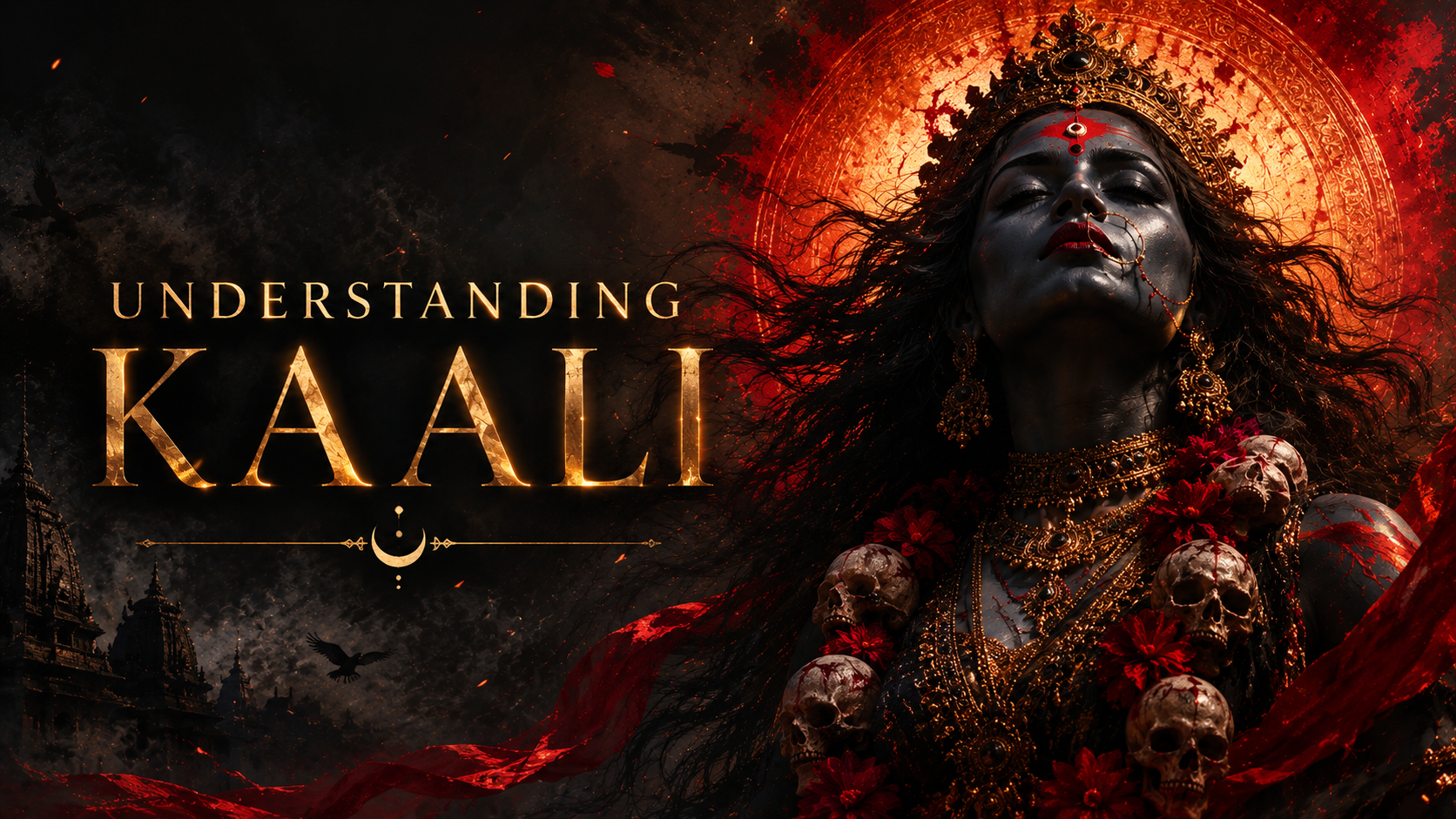
Her dark complexion represents the infinite void, the vastness beyond ego, identity, and form. Her wild hair symbolizes freedom from conditioning and social control. The skulls she wears represent the death of false identities and attachment to the egoic self. Even the cremation ground associated with her is symbolic. It represents impermanence, the place where attachment dissolves and illusion dies.
This is why Kaali feels intense.
She does not allow illusion to remain intact simply because it feels emotionally comfortable.
Modern spirituality often romanticizes healing into something visually beautiful and emotionally soothing. But real transformation rarely begins that way. Sometimes healing first appears as grief. Sometimes, as rage. Sometimes, due to exhaustion. Sometimes as the painful realisation that we have abandoned ourselves for years in order to remain accepted.
Kaali governs this threshold between illusion and truth.
☾ ◯ ☽
Kaali and Feminine Conditioning
For women especially, Kaali becomes deeply significant because she confronts conditioning around acceptable femininity.
Women are often taught to suppress intensity to remain desirable, digestible, emotionally manageable, and socially acceptable. Anger is discouraged. Boundaries are softened. Emotional truth is swallowed repeatedly in the name of being “good,” nurturing, composed, or spiritually evolved.
But suppression does not create peace.
It creates fragmentation.
Many women carry enormous amounts of unprocessed grief, resentment, exhaustion, shame, and emotional self-betrayal within the nervous system while continuing to appear functional externally. Over time, this creates a profound split between the performed self and the authentic self.
Kaali destroys this split.
Not gently, necessarily. But honestly.
This is one of the reasons she has historically been feared. She embodies feminine power without apology. Not performative power. Not an aesthetic “dark feminine” performance. Real power… the kind that emerges when a woman stops abandoning her own truth.
☾ ◯ ☽
Kaali and Ego Dissolution
Psychologically, Kaali can also be understood as the force of ego dissolution.
Not ego death in the dramatic way modern spirituality often speaks about it, but the dismantling of identities built entirely around fear, validation, attachment, and survival.
Every human being constructs versions of themselves to secure love, approval, safety, or belonging. But eventually those identities become exhausting because they require constant self-suppression to maintain.
This is why Kaali energy often enters during periods where people can no longer continue performing versions of themselves that feel emotionally false.
She asks difficult questions.
- Who are you beneath performance?
- What are you still tolerating out of fear?
- What truth are you avoiding because it would require your life to change?
- What version of yourself is already trying to die?
Kaali does not remove what is real. She removes what is preventing reality from being faced honestly.
☾ ◯ ☽
Kaali and Shadow Work
Kaali archetype work is deeply connected to shadow work because she governs the emotional material most people avoid confronting — rage, grief, shame, fear, attachment, emotional dependency, suppressed desire, and fear of truth itself.
But Kaali does not ask people to become emotionally destructive or theatrically “dark.” She asks for honesty.
This is where modern interpretations often become distorted. Much of contemporary “dark feminine” culture confuses healing with emotional hardness, superiority, hyper-independence, or aesthetic performance. Kaali has nothing to do with performance.
In fact, she dismantles performance… Real work with Kaali is often quiet externally but radical internally. It may look like ending cycles of self-abandonment, grieving consciously instead of suppressing emotion, leaving relationships rooted in emotional distortion, setting boundaries without guilt, or finally acknowledging truths that have been avoided for years.
The transformation is internal, long before it becomes visible externally.
☾ ◯ ☽
Why So Many Women Feel Drawn Toward Kaali Today
The growing attraction toward Kaali is not accidental.
Many women today are exhausted from sustaining identities disconnected from truth. They are tired of emotional suppression disguised as maturity, self-abandonment disguised as love, and spiritual bypassing disguised as healing.
Kaali becomes relevant precisely at the point where something within the psyche refuses to continue living divided.
This is why women are often drawn toward her during periods of awakening, grief, heartbreak, reinvention, burnout, or emotional transformation. Not because they seek destruction. But because something within them can no longer tolerate illusion.
☾ ◯ ☽
The Real Meaning of Kaali
Ultimately, Kaali is not a goddess of punishment. She is a goddess of awakening.
She represents the intelligence within existence that dissolves what is false so truth can emerge unobstructed. She reminds us that transformation is not always graceful or emotionally comfortable. Sometimes growth requires the collapse of identities, attachments, relationships, and beliefs built entirely on fear.
Kaali teaches that liberation cannot happen without honesty. And perhaps this is why her presence feels so powerful. Because at her core, Kaali is not asking us to become darker. She is asking us to become real.
“I am the divine force that resides within you, unshackling you from all that binds you, and giving you the strength to rise.”
Reverence to the Dark Goddess, the mother of all creation and destruction!




0 Comments